
Daily Clutter Systems: Why Your Home Keeps Getting Messy (and How to Fix It)

If your home keeps getting messy no matter how often you tidy, here’s the truth: it’s not laziness, and it’s not a lack of effort. It’s missing systems. The homes that stay calm aren’t run by tidier people: they’re run by simple, repeatable daily clutter systems that quietly handle the mess before it builds.
I learned this the hard way. For years I blamed myself: if I just tried harder, cleaned more, cared more, my house would stay neat. But willpower was never the problem. The moment I stopped relying on motivation and started building daily clutter systems, my home finally stayed manageable, even with two kids and a busy week.

Why your home keeps getting messy
Clutter rarely comes from one big mess. It builds from dozens of tiny postponed decisions: the mail you set down “for later,” the jacket on the chair, the toy left mid-floor. Each one is small, but they pile up fast.
There’s real science behind why this drains you. Every undecided object adds a little to your mental load: psychologists call the slow toll of constant small choices decision fatigue. And a cluttered home keeps that meter running all day. A UCLA study of family homes even linked higher clutter to higher daily stress hormones, especially for moms.
So the goal of daily clutter systems isn’t a spotless house. It’s fewer decisions, less mental noise, and a home that resets itself without you having to think.


Laundry Basket with Lid, Clothes Hampers for Laundry with Bamboo Handles and A Removable Bag
Shop on AmazonWhat a “clutter system” actually is
A system is just a decision you make once so you don’t have to keep making it. Instead of wondering where the keys go every day, you decide once: keys live in this bowl. Done. The thinking is over.
Good daily clutter systems share three traits: they’re small, they’re repeatable, and they don’t rely on you being in the mood. Here are the core ones that keep my home calm.
1. Give everything a landing spot
Most clutter is just homeless objects. Keys, chargers, mail, the kids’ shoes: they float around because they don’t have a clear place to land.
Walk through your messiest spots and give each floating item one home. A bowl by the door. A basket for chargers. A tray for daily clutter. Once everything has a place, tidying stops being a decision and becomes a five-second reflex. This is the foundation every other system is built on.
2. Handle it once
So much daily clutter comes from “I’ll deal with it later.” Later rarely comes: or it arrives as one exhausting pile. The fix is to finish the decision the moment you touch something: mail sorted as it arrives, jacket hung, dish straight into the dishwasher.
It’s such a powerful habit that I gave it its own guide: read it here: the OHIO method (Only Handle It Once). It’s one of the simplest daily clutter systems you can adopt today.
3. The daily ten-minute reset
This is the engine of the whole thing. Once a day, I do it after dinner, set a ten-minute timer and return things to their homes. Surfaces cleared, the next day set up to start calm.
Ten minutes a day keeps a house steadier than any three-hour weekend deep clean. The deep clean fixes today; the daily reset stops the mess from ever reaching “overwhelming.”
4. One in, one out
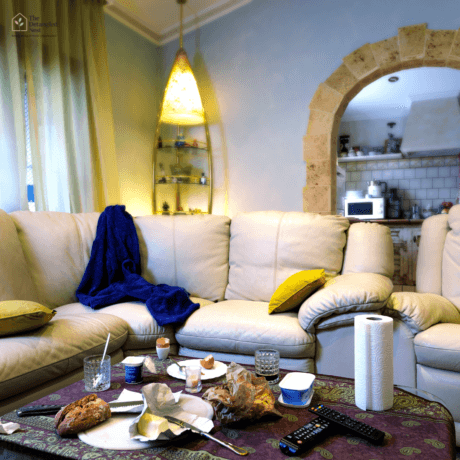
Clutter creeps back because new things keep walking in the door. The “one in, one out” rule fixes that quietly: something new comes home, something old leaves. A new mug means an old one goes.
It forces a tiny pause at the only moment that really matters: before something enters your home. Over time, it changes what you buy in the first place. If you’re starting from an already-full house, pair this with my gentle approach to decluttering without stress.


5. Contain it with boundaries
A system needs edges. A basket that’s full is a built-in signal: time to edit, not to buy a bigger basket. Baskets and bins turn vague “stuff” into contained, resettable zones: the kids’ toys live here, the throws live there.
This is especially powerful in a small home, where every surface counts. These are the storage baskets for small spaces I lean on to keep daily clutter contained.
6. Patrol your hot spots
Every home has two or three spots where clutter always lands: the kitchen counter, the entryway, the end of the stairs. Instead of fighting the whole house, give those hot spots a daily glance and reset them first. Win the hot spots and the rest of the house follows.
These are almost always your high-traffic zones: entryways, kitchens, bathrooms, and living rooms absorb constant movement, so micro-mess builds there faster than anywhere else. The fix isn’t cleaning those rooms more: it’s giving them fast, obvious landing spots so clutter gets contained the moment it appears.
Why cleaning alone never makes it stick
Here’s the distinction that changes everything: cleaning removes dirt, but it doesn’t stop clutter from coming back. Cleaning is an action that depends on energy, time, and motivation: and all three change daily. Containment is structure: baskets, trays, and drop zones that catch clutter at the moment it forms, before it spreads.
That’s why tidying feels endless when there’s no system underneath. You reset a space, real life resumes, someone walks in with bags, a task overlaps, you set something down “for a second”, and the reset quietly unravels. A calmer home isn’t cleaner; it’s better prepared for those interruptions. When your space can absorb a pause without falling apart, order finally lasts: not because you did more, but because the structure did its part.
One rule beats ten habits
Most clutter hides in flat, open surfaces: counters, tables, chairs. An empty surface reads to the brain as a temporary holding zone, so things land there without a decision. The fix isn’t willpower; it’s giving each surface a boundary. A tray says things pause here. A basket says drop it here for now.
And you don’t need ten new habits to do it: you need one clear rule per clutter zone. Papers always go in one tray, not “any flat surface.” Bags hang in one spot, not “wherever there’s space.” Once the rule exists, the decision is already made, and clutter has nowhere to pause.
How to build your own daily clutter systems
Don’t try to install all six at once: that’s a recipe for overwhelm, and overwhelm is exactly what we’re trying to avoid. Pick the one that targets your biggest daily frustration and let it become automatic before adding the next.
This step-by-step, low-pressure mindset is the same one behind how I simplify my home as a whole. Systems beat willpower every time.
Where to start
If you only build one of these daily clutter systems this week, make it the ten-minute evening reset. It gives the fastest sense of relief and naturally pulls the other habits along with it.
And if you have kids, please don’t aim for spotless: aim for resettable. A calm family home isn’t one that’s never messy; it’s one that’s easy to put back together. That’s what good systems give you: not a perfect house, but a peaceful one that mostly takes care of itself.
Printable workbook
Daily Clutter Systems
Stop mess before it starts, with simple systems that stick.
- Identify your daily clutter triggers
- Build an entry drop zone + kitchen reset
- Create your own daily clutter plan
Instant download • Personal use only

Frequently asked questions
What are daily clutter systems? They’re small, repeatable habits that stop clutter before it builds: like giving every item a home, doing a ten-minute daily reset, and following the “one in, one out” rule. Instead of relying on motivation, you set up systems that quietly maintain your home for you.
Why does my house get messy so fast even when I clean? Because cleaning removes today’s mess but doesn’t stop tomorrow’s. Without systems, new clutter keeps arriving faster than you can clear it. Daily clutter systems target the cause, postponed decisions and homeless objects, rather than just the symptom.
How do I keep my home tidy with kids? Lower the bar from “spotless” to “resettable.” Use clear bins kids can reach, keep fewer toys in rotation, and build a quick family reset into the evening. The goal is a home that’s easy to put back together, not one that’s never messy.
How long does it take for clutter systems to work? You’ll feel relief almost immediately from a daily reset, but the systems become truly automatic after a few weeks of repetition. Start with one, let it stick, then layer in the next.



42 Comments