
Simple Ways to Simplify Your Home: 10 Calm, Clutter-Free Steps
If you want to simplify your home, it’s tempting to wait for one big, heroic declutter: a free weekend, a stack of donation bags, and the feeling that you’ve finally “gotten on top of it.” For the longest time, that’s exactly what I believed. So I’d do it. I’d spend a Saturday sorting and hauling, feel amazing for about three days: and then watch the clutter quietly creep back in by the middle of the next week. Shoes by the door. Mail on the counter. That one chair that somehow becomes a wardrobe. What I eventually figured out, after a lot of trial and error in a house with two kids, is that simplifying isn’t a one-time event. It’s a handful of small habits you repeat without thinking. The deep clean clears the room. The habits are what keep it clear. And that heavy, low-grade stress of a cluttered home isn’t just in your head: a well-known UCLA study of family homes linked higher clutter to higher daily stress hormones, especially for moms. So this isn’t really about a tidier shelf. It’s about feeling lighter in your own space. Here are ten that actually stuck for me. You don’t need to do all of them. Pick one, let it become automatic, then add the next.
1. Start with one surface, not the whole house
The fastest way to give up is to look at the entire house at once. It’s too much, so we freeze. Instead, pick one surface: the kitchen counter, the nightstand, the entryway table. Clear just that. The point isn’t the surface itself; it’s the small hit of “I can do this” that makes you want to keep going. Momentum is gentler than motivation, and it lasts longer.
2. Let “good enough” be the goal
Perfectionism is sneaky. It dresses up as high standards, but really it just keeps you from starting. If the only acceptable outcome is a magazine-perfect room, you’ll never feel finished, and you’ll resent the whole process. A home that’s 80% tidy and easy to maintain beats a home that’s perfect for one afternoon and impossible to keep up. Aim for calm and livable, not flawless.
Printable workbook
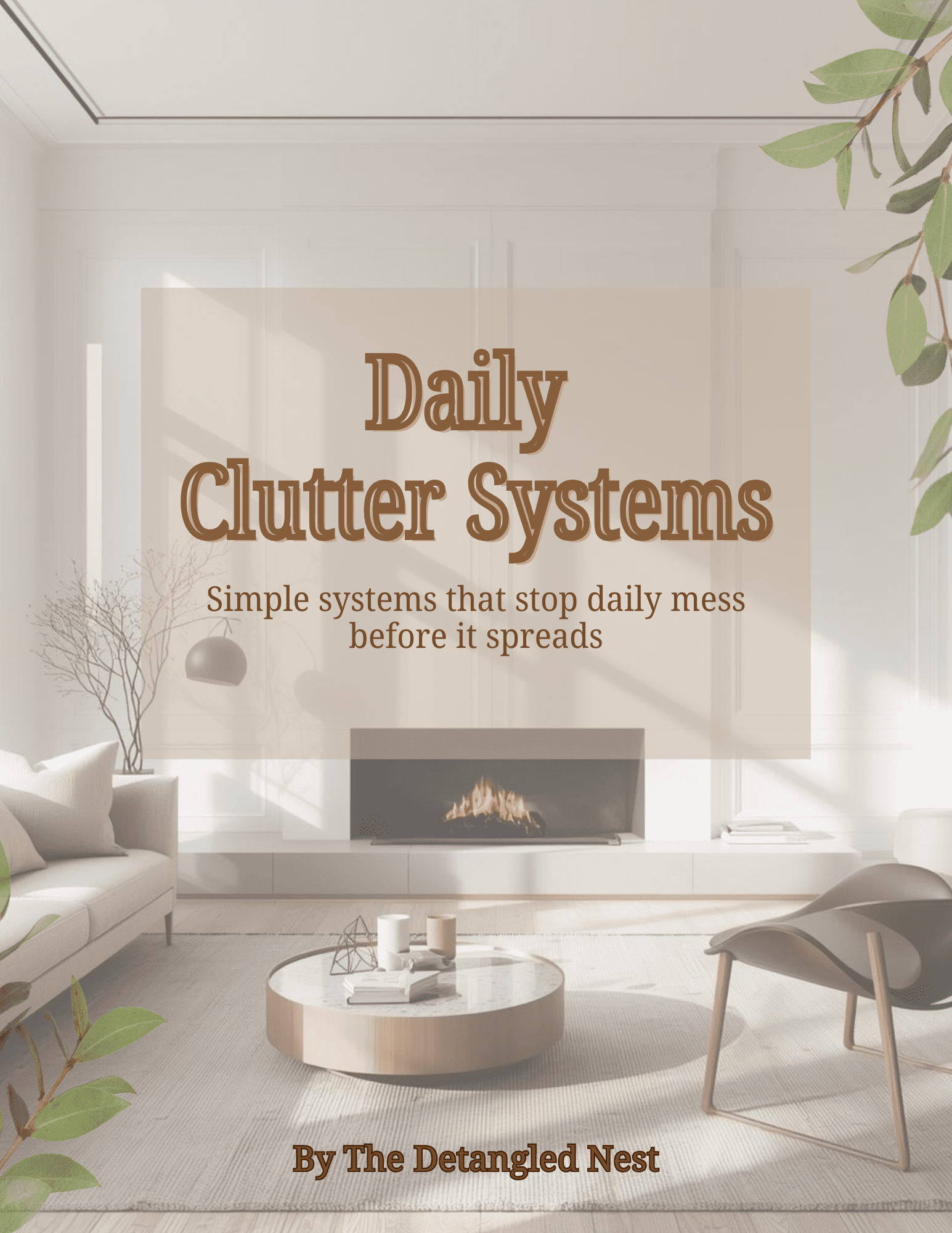
Daily Clutter Systems
Stop mess before it starts, with simple systems that stick.
- Identify your daily clutter triggers
- Build an entry drop zone + kitchen reset
- Create your own daily clutter plan
Instant download • Personal use only
3. Give everything a home
Giving every object a place is one of the simplest ways to simplify your home for good. Most clutter isn’t really clutter: it’s homeless objects. Keys, chargers, library books, the kids’ art. They float around the house because they don’t have a clear place to land. Walk through your most cluttered spots and ask one question: where does this actually belong? Then make that the answer, every time. Once everything has a home, tidying stops being a decision and becomes a reflex. This idea is the backbone of the simple daily clutter systems that keep my house from spiraling.

Hotel Lobby Signature Candle
Soy Wax with Amber, Cedar, and Musk – Infused with Essential Oils
Buy on Amazon
Luxury Scented Candle Gift
Queen Of The Night Rare Flower Fragrance in Elegant Glass Jar
Buy on Amazon4. Use the “one in, one out” rule
Here’s the part most decluttering advice skips: clutter comes back not because you didn’t declutter, but because new things keep walking in the door. The “one in, one out” rule fixed that for me. Something new comes home, something old leaves. A new mug means an old one goes. New shoes, old shoes out. It forces a tiny pause at the only moment that really matters: before the thing enters your home. Over time it quietly changes what you buy in the first place.

Faux Book Storage Box Set
Decorative Faux Books with Hidden Storage for Coffee Table Decor, Bookshelf or Mantle
Buy on Amazon
Minimalist Wall Art for Living Room
Beige Modern Wall Art | Large Framed Boho Canvas Painting
Buy on Amazon5. Clear the floor first
If you only have five minutes, spend them on the floor. There’s something about a clear floor that makes a whole room read as “calm,” even if the shelves are still a little busy. Bags, shoes, laundry baskets, toys: get them off the ground and into their homes. It’s the single change that gives the biggest visual payoff for the least effort.

Throw Pillow Covers
Square Pillow Covers Chenille Tufted Pillow Cases Accent Neutral Pillowcase for Living Room Couch Bed, Orange White
Buy on Amazon
6. Build tiny daily resets
These tiny resets are how I simplify my home without it ever taking over my weekend. This is the habit that changed the most for me. Not a cleaning schedule, not a chore chart: just two small resets. In the morning, I make the bed before I leave the room. In the evening, I do a ten-minute tidy: surfaces wiped, things returned to their homes, the next day set up to start calm. Ten minutes a day kept my house steadier than any three-hour weekend session ever did. If the idea of “another routine” makes you tired, start with one. Just the evening reset. That’s it.


7. Handle things once
So much of my old clutter came from postponed decisions. I’d set the mail down “for later,” drape the jacket over a chair, leave the dishes “for after.” Later rarely came: and when it did, it came as one big, exhausting pile. The fix is simple: when you pick something up, finish the decision then and there. Mail gets sorted as it arrives. The jacket gets hung. The dish goes straight in the dishwasher. I wrote a whole post on this one because it made such a difference: you can read it here: the OHIO method (Only Handle It Once). 
8. Declutter before you organize
If you want to simplify your home, pare down first: organizing comes last. It’s tempting to buy bins and baskets the moment you decide to simplify. But organizing clutter just gives it a nicer-looking home: you still own all of it. Pare down first. Decide what actually earns a place in your daily life, let the rest go, and then organize what’s left. Organizing should be the last step, not the first. If the thought of decluttering feels heavy, take the gentle, low-pressure approach in my guide to decluttering without stress.
9. Use baskets as boundaries
Once you’ve pared down, a few good containers do a lot of quiet work. Not as a way to hide more stuff, but as boundaries: the basket is full, so that’s the limit. The kids’ toys live in this bin. Throw blankets go in that one. Boundaries make a small space feel calmer and easier to reset, because everything has an edge. If you’re short on room, these are the storage baskets for small spaces I keep coming back to.


10. Protect the calm
To simplify your home long-term, the work shifts from clearing to protecting. This is the one nobody talks about. Once your home feels lighter, the work shifts from clearing to protecting. Slow down what comes in. Pause before you buy. Say no to the freebies and the impulse finds. Ask whether something will genuinely add to your day or just become tomorrow’s clutter. Simplifying your home isn’t a project you finish once: it’s a quiet practice of protecting the calm you worked to create. It also lightens the invisible mental load: the constant noticing, planning, and keeping-track that clutter quietly piles onto you in the background.

Where to start
If this list feels like a lot, it is: and you don’t need it all today. Pick the one that made you nod the hardest and start there. For most people, the evening ten-minute reset (step 6) gives the fastest sense of relief. Simplifying your home was never really about the stuff. It’s about making room: for clarity, for rest, for the life you actually want to live in it. One small change at a time is more than enough. You don’t need to simplify your home in a day. Learning to simplify your home was never really about the stuff. It’s about making room: for clarity, for rest, for the life you actually want to live in it. Learning to simplify your home was never really about the stuff.
Frequently asked questions
How do I simplify my home when I feel completely overwhelmed? Shrink the task until it feels almost too easy. Don’t think about the house: think about one surface, or one drawer. Set a ten-minute timer and stop when it goes off. Overwhelm comes from the size of the goal, so make the goal small. What’s the difference between decluttering and simplifying? Decluttering is removing what you don’t need. Simplifying is building habits and systems so the clutter doesn’t pile back up. Decluttering is the event; simplifying is the ongoing practice that keeps it from undoing itself. How do I keep my home simple with kids around? Lower the bar and build it into the routine. Fewer toys in rotation, clear bins kids can reach themselves, and a quick family reset before bed do more than any perfect system. A calm home with kids isn’t a quiet, spotless one: it’s one that’s easy to put back together. I share more on that here. How long does it take to simplify your home? There’s no finish line, and that’s good news. You’re not racing to “done”: you’re building habits that make every day a little lighter. Most people feel a real difference within a week of starting one small daily reset. Disclaimer: This post may contain affiliate links. That means if you click and make a purchase, I may earn a small commission at no extra cost to you. I only recommend products I truly love and believe add value to your life. Thank you for supporting The Detangled Nest: it helps me continue creating free content for you.


20 Comments